
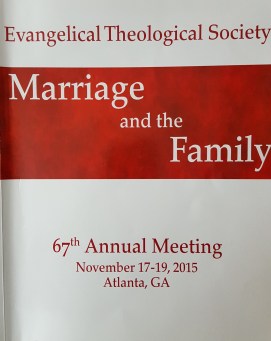
 One of the great opportunities I have been afforded is to participate in annual conferences of the Evangelical Theological Society (ETS), the Society of Biblical Literature (SBL), and the American Academy of Religion (AAR), and I am currently in Atlanta for this year’s round of conferences. Last night I attended my final session associated with ETS, and will begin a long list of SBL/AAR sessions first thing tomorrow morning. One of the great things about these conferences is the reminder that the body of Christ is a diverse, multifaceted community of faith. Far too often, however, Christians of a particular community (denomination, etc.) seem to view folks in other communities as if they were somehow at best deficient-Christians, and at worst not Christian’s at all. When asked by the Philippian jailor, “What must I do to be saved?”, Paul and Silas responded, “Believe in the Lord Jesus, and you will be saved” (Acts 16:30-31 ESV). Paul later states, “If you confess with your mouth that Jesus is Lord and believe in your heart that God raised him from the dead, you will be saved” (Romans 10:9 ESV). Thus, faith in Jesus is what makes a person a “Christian,” not membership in a particular community. All those who are “in Christ,” a favorite expression of the Apostle Paul, are members of the body of Christ, and thus are to be honored and valued no matter which particular community they may identify with. What I am not saying is that doctrines held by these communities are unimportant, because they are in fact quite important. And there are indeed significant doctrinal differences between various communities. But in addressing these differences, no matter how contentious they may be, we need to exercise Christian love and charity as we interact with our Christian brothers and sisters in the process. It is God who calls and in-grafts fallen sinners into His body, the church, thus we need to honor and respect those who have been so in-grafted, trusting that God knows what He is doing!

 “Passing on the Faith”